
Commercial gas boilers in the North East work harder than most. From bitter Northumberland winters to the year-round heating demands of offices, schools, care homes and industrial premises across Tyneside and Teesside, a boiler failure is never just an inconvenience. It can mean regulatory non-compliance, genuine safety risks and costly downtime for the people who depend on your premises.
Yet many facility managers and property owners are unclear on exactly what servicing a commercial gas boiler actually requires, how often it must happen, and who is legally qualified to carry it out. The Gas Safety (Installation and Use) Regulations 1998 require that gas appliances, fittings and flues on commercial premises are maintained in a safe condition. The Health and Safety at Work Act 1974 places a further duty on employers to ensure, so far as is reasonably practicable, the health and safety of people on their premises — which includes properly maintained heating plant.
This article sets out the eight key service checks and maintenance activities your commercial gas boiler needs, what each one involves, and what to look for when arranging them. One point applies to every item on this list: all gas work on commercial premises must be carried out by a Gas Safe registered engineer. You can verify any engineer's registration at the Gas Safe Register website.
Best for: All commercial premises with gas boilers — the legally expected minimum for duty holders.
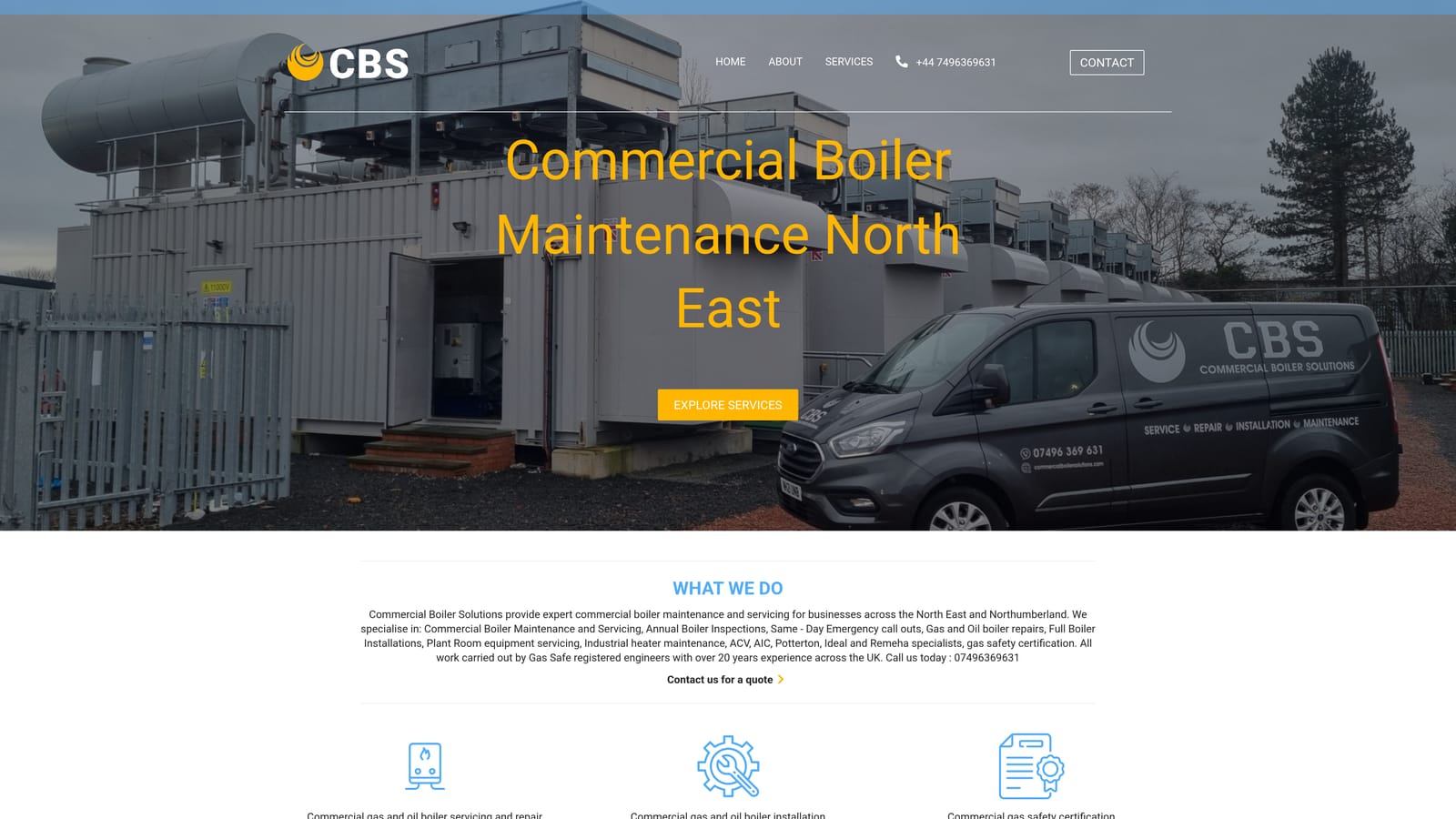
Commercial Boiler Solutions provides comprehensive annual commercial boiler servicing across the North East and Northumberland, carried out by Gas Safe registered engineers.
Annual servicing is the industry-standard minimum for commercial gas boilers, consistent with HSE guidance and manufacturer recommendations. For high-usage premises such as care homes, hotels, schools and large office blocks, interim checks every six months are often advisable given the additional demands placed on the plant.
A proper annual service is not simply a visual inspection. It involves stripping down key components, cleaning where necessary, testing safety devices and documenting the outcome — giving the duty holder a clear record of compliance and the boiler a clean bill of health heading into the heating season.
Full boiler strip-down inspection and clean: Internal components are accessed, inspected and cleaned to remove soot, debris and deposits that reduce efficiency and increase wear.
Burner and ignition system check: The burner is inspected for correct operation, ignition reliability and flame pattern — early indicators of combustion problems.
Safety device operation test: Pressure relief valves, overheat thermostats and other safety devices are tested to confirm they operate correctly and within specification.
Flue integrity and terminal check: The flue system is inspected for damage, blockage or deterioration that could allow combustion gases, including carbon monoxide, to enter the building.
Service record documentation: A written service record is issued to the duty holder, providing documented evidence of maintenance for compliance purposes.
Every commercial property with a gas boiler, regardless of size or usage. Duty holders — including employers, landlords and managing agents — are responsible for ensuring gas appliances on their premises are maintained safely. An annual service by a Gas Safe registered engineer is the foundation of that responsibility.
Varies by boiler type, output and location. Contact Commercial Boiler Solutions for a tailored quote covering your site.
Best for: Identifying carbon monoxide risk and confirming the boiler is burning fuel cleanly and efficiently.
Flue gas analysis is a diagnostic test measuring the composition of exhaust gases from the boiler to assess combustion quality and identify any risk of incomplete combustion.
Incomplete combustion produces carbon monoxide, an odourless and colourless gas that poses a serious risk to building occupants. Flue gas analysis gives the engineer precise measurements of CO, CO2 and flue gas temperature, allowing them to calculate combustion efficiency and identify whether the air-to-fuel ratio is correctly set.
For commercial boilers running long daily cycles across a North East heating season that can stretch from September through to April, even a modest loss of combustion efficiency adds up across the year. This test provides the data needed to correct it.
Carbon monoxide and carbon dioxide measurement: Precise gas analysis confirming combustion products are within safe and acceptable limits.
Flue gas temperature reading: Elevated flue temperatures can indicate heat exchanger fouling or incorrect burner settings, both of which reduce efficiency.
Combustion efficiency calculation: A percentage figure allowing comparison against the boiler's rated efficiency and tracking of deterioration over time.
Air/fuel ratio assessment: Identifies whether the burner is running rich or lean, allowing adjustment to optimise performance.
Typically carried out as part of the annual service: No separate appointment is usually required — this is standard practice within a thorough annual inspection.
All commercial gas boilers, but particularly older plant, boilers that have shown signs of reduced efficiency, and any premises where occupant safety is a primary concern — including care homes, schools and residential blocks across Tyneside and Wearside.
Usually included within an annual service package. If efficiency concerns are identified between services, a standalone test can be arranged.
Best for: Duty holders requiring formal documented evidence of gas safety compliance on their premises.
The HSE's guidance on commercial gas safety makes clear that duty holders are responsible for ensuring all gas appliances, pipework and flues on their premises are maintained in a safe condition. A formal gas safety inspection produces the documented evidence to demonstrate this.
Unlike the domestic landlord gas safety certificate, there is no single prescribed commercial equivalent — but the duty to maintain and the requirement to keep records is no less real. A formal gas safety inspection provides a written record identifying any immediately dangerous (ID) or at-risk (AR) defects, which duty holders are required to act upon promptly.
For commercial landlords, managing agents and facilities managers across Newcastle, Middlesbrough and Northumberland, this documentation also provides important protection in the event of an insurance claim or regulatory enquiry.
Gas tightness test: Pipework and connections are tested to confirm there are no gas leaks on the installation.
Appliance safety check: Each gas appliance is inspected against current safety standards to confirm it is safe to use.
Flue flow and spillage test: Confirms that combustion gases are being safely expelled from the building rather than spilling into occupied spaces.
Written inspection record: Issued to the duty holder and retained as evidence of compliance with the Gas Safety (Installation and Use) Regulations 1998.
Defect classification: Any faults found are classified as immediately dangerous, at-risk or advisory, with clear guidance on required action.
Commercial landlords, managing agents, schools, care homes and any organisation with a formal duty to demonstrate gas safety compliance. Often carried out in conjunction with the annual service to minimise disruption and cost.
Varies depending on the number of appliances and complexity of the installation. Often combined with the annual service; standalone inspections are available where required.
Best for: Preventing repeated pressure loss, boiler lockouts and sealed system damage.
Pressurisation unit and expansion vessel checks are an inspection of the sealed system components that maintain correct operating pressure throughout the heating circuit.
A waterlogged or failed expansion vessel is one of the most common causes of recurring low-pressure faults on commercial boilers. When the vessel loses its pre-charge pressure, the system has no capacity to absorb thermal expansion — leading to repeated pressure relief valve operation, pressure loss and boiler lockout.
In a busy commercial property, repeated lockouts mean repeated manual resets, engineer callouts and, eventually, plant room flooding if the pressure relief valve discharges frequently. Catching a failing vessel during a routine service avoids all of that.
Expansion vessel pre-charge pressure test: The nitrogen pre-charge is checked against the system's static fill pressure and corrected or the vessel replaced if required.
Pressurisation unit operation check: The automatic pressurisation unit (where fitted) is tested to confirm it maintains system pressure within the correct range.
System pressure monitoring: Operating pressure is checked at cold and hot conditions to identify any underlying loss of water from the system.
Pressure loss cause identification: If the system is losing pressure, the engineer investigates whether the cause is a leaking vessel, a weeping joint or another component fault.
Included in thorough annual service: This check should form part of every comprehensive annual service, not an afterthought.
Any commercial premises with a sealed heating system — which covers the majority of modern commercial boiler installations. Particularly important for older plant where expansion vessels may be original to the installation.
Included within a comprehensive annual service. Vessel replacement or pressurisation unit repair is priced separately depending on the component and system involved.
Best for: High-output boilers, older plant and properties in areas with harder water supply.
Heat exchanger inspection and descaling is a targeted assessment of the boiler's primary heat transfer surface for soot deposits, limescale and corrosion.
The heat exchanger is where the energy from combustion transfers into the heating circuit. Soot deposits on the fire side and limescale deposits on the water side both act as insulation, reducing heat transfer and forcing the boiler to burn more fuel to achieve the same output. In severe cases, localised overheating from soot accumulation can cause heat exchanger failure.
For commercial boilers running long daily cycles — common in care homes, schools and industrial premises across Teesside and Northumberland — this degradation can develop faster than many operators realise.
Visual and probe inspection of heat exchanger surfaces: The engineer accesses the heat exchanger to assess the extent of any soot or scale accumulation.
Soot and scale removal: Where deposits are found, cleaning is carried out to restore heat transfer efficiency and reduce the risk of overheating.
Heat exchanger condition assessment: The engineer assesses the overall condition of the heat exchanger and provides an opinion on remaining service life — useful for capital planning.
Chemical inhibitor check: System water inhibitor levels are checked and a top-up recommended if levels are low, reducing the risk of future corrosion and scale formation.
Particularly relevant for older plant: Heat exchangers on boilers over ten years old warrant closer attention, particularly in properties with hard water supply or a history of poor water treatment.
High-output commercial boilers, older installations and any property where the system water treatment history is unclear. Also relevant following a boiler repair involving system water loss, which can introduce fresh, untreated water into the circuit.
Inspection is included within a thorough annual service. Chemical treatment, descaling or heat exchanger replacement is priced separately based on the work required.
Best for: Ensuring the boiler fires correctly, heats efficiently and integrates properly with building controls.
Controls and BMS checks are a functional inspection of all boiler controls, time and temperature settings, zone thermostats and building management system (BMS) integration where fitted.
A boiler that is mechanically sound but controlled incorrectly can still waste significant amounts of energy and fail to heat the building effectively. A faulty zone valve, a miscalibrated thermostat or a BMS signal fault can mean entire sections of a building receive no heat — or that the boiler fires continuously when it should not.
This check is particularly valuable as a pre-season activity. In the North East, where the heating season typically begins in earnest from September or October, identifying control faults before the first cold spell means problems are resolved before they affect building occupants.
Boiler thermostat and high-limit stat calibration check: Operating and safety thermostats are verified to confirm they respond correctly at the correct temperatures.
Time clock and programmer verification: Heating schedules are checked to confirm they match the building's occupancy patterns and have not drifted due to power interruptions.
Zone valve and motorised valve operation test: All zone valves are operated to confirm they open, close and signal correctly — a common failure point on older systems.
BMS signal and interlock check: Where a building management system is fitted, the engineer confirms the boiler responds correctly to BMS demand signals and that interlocks function as intended.
Recommended as a pre-season check: Ideally carried out in August or September ahead of the North East heating season.
Any commercial premises with zoned heating, time-controlled operation or BMS integration — which includes most offices, schools, care homes and multi-tenancy commercial properties across Newcastle, Sunderland and the wider region.
Included within a comprehensive annual service. BMS integration work or control system upgrades are quoted separately depending on the scope involved.
Best for: Identifying corrosion, leaks and mechanical wear in the plant room before they become dangerous.
Safety valve, pipework and connections inspection is a visual and functional check of the pressure relief valves, gas pipework, flexible connectors and visible joints within the plant room.
Plant rooms in commercial properties are not always visited frequently between service intervals. Corrosion on gas pipework, a weeping flexible connector or a pressure relief valve that has partially lifted and not reseated can go unnoticed for months. By the time a fault becomes obvious, it may already represent a safety risk.
This inspection is particularly relevant in older plant rooms — common across commercial properties in Newcastle, Middlesbrough and Northumberland — where pipework may be decades old and flexible connectors may be overdue for replacement.
Pressure relief valve condition check: The valve is inspected for signs of previous operation, corrosion or mechanical damage that could prevent it from functioning correctly in an overpressure event.
Gas pipework visual inspection: Accessible gas pipework is inspected for corrosion, mechanical damage and any signs of previous interference or unsatisfactory repair.
Flexible connector condition assessment: Flexible gas connectors have a finite service life; the engineer assesses their condition and advises replacement where warranted.
Visible joint and fitting inspection: Compression fittings, flanged connections and other visible joints are inspected for signs of weeping or deterioration.
Gas tightness test on accessible pipework: A gas tightness test confirms that no gas is escaping from the installation.
All commercial properties, but especially those with older plant rooms or where the maintenance history is incomplete. If you suspect a gas leak at any time, leave the area immediately and call the National Gas Emergency Service on 0800 111 999 — do not attempt to investigate it yourself.
Included within a comprehensive annual service and gas safety inspection. Component replacement — such as flexible connectors or safety valves — is priced separately based on parts and labour.
Best for: Commercial properties that cannot afford extended heating downtime when a boiler fault occurs outside of planned maintenance.
Commercial Boiler Solutions provides rapid-response emergency callout and reactive maintenance for commercial boiler breakdowns across the North East and Northumberland.
Planned servicing reduces the likelihood of breakdowns, but it cannot eliminate them entirely. Commercial boilers are complex plant operating under demanding conditions, and component failures do occur. When they do, the speed of response matters enormously — particularly for care homes, schools and other premises where loss of heating or hot water has immediate consequences for vulnerable occupants.
Having a reliable, Gas Safe registered engineer available for emergency response is as important a part of your maintenance strategy as the annual service itself. It is also worth noting that an engineer who is already familiar with your plant from annual servicing can often diagnose and resolve faults more quickly than one attending the site for the first time.
Same-day emergency response: Commercial boiler faults are attended promptly, minimising heating downtime for your property and its occupants.
Fault diagnosis and repair by Gas Safe registered engineers: All reactive work is carried out by engineers whose registration can be verified on the Gas Safe Register.
Component replacement from stock where possible: Common replacement parts are carried to site, reducing the need for return visits and further downtime.
Coverage across the North East and Northumberland: Emergency callouts are available across Newcastle, Sunderland, Middlesbrough, Tyneside, Wearside, Teesside, Northumberland and North Yorkshire.
5-star rated service: Commercial Boiler Solutions holds a 5-star customer rating, reflecting a consistent record of prompt and professional response.
Any commercial property with gas heating, but particularly premises where heating downtime carries immediate regulatory, welfare or reputational consequences — care homes, schools, hotels, NHS facilities and multi-tenancy commercial buildings across the region.
Contact Commercial Boiler Solutions for emergency callout rates and to discuss maintenance contract options that combine planned servicing with reactive cover.
The eight checks and services covered in this article are not alternatives to one another — they work together as a complete maintenance picture. Annual servicing by a Gas Safe registered engineer is the foundation, and most of the other checks on this list are carried out as part of that service. The exceptions are emergency callout cover and any remedial work that arises from inspection findings.
As a general guide, most commercial gas boilers should be serviced at minimum once per year, with the service timed to coincide with the period just before peak demand. In the North East, that means aiming for completion by the end of September or early October at the latest, before the region's typically cold winters place full demand on the plant.
High-usage premises — care homes, hotels, schools, large office blocks — should consider interim checks every six months. Older plant, or boilers with a history of faults, warrants closer attention still.
Duty holders have a legal responsibility under the Gas Safety (Installation and Use) Regulations 1998 and the Health and Safety at Work Act 1974 to keep gas appliances on their premises maintained safely. Documented service records are the evidence that responsibility has been met.
Commercial Boiler Solutions is Gas Safe registered and provides commercial boiler servicing, gas safety inspections, emergency callouts and maintenance contracts across Newcastle, Sunderland, Middlesbrough, Tyneside, Wearside, Teesside, Northumberland and North Yorkshire. If your annual service is due — or overdue — or you would like to discuss a maintenance contract that covers both planned and reactive work, get in touch with the team today. Learn more about our services and arrange a quote for your property.