
For commercial property owners and facility managers across the North East and Northumberland, staying on top of gas system maintenance is a legal obligation, not an optional extra. Under the Gas Safety (Installation and Use) Regulations 1998 and the Health and Safety at Work Act 1974, you have a clear duty to ensure gas appliances, pipework and flues are maintained in a safe condition at all times.
Knowing what that looks like in practice is another matter. Whether you manage a single commercial unit in Newcastle or a portfolio of properties stretching across Teesside and Northumberland, the right combination of services, standards and tools makes all the difference between a reactive scramble and a robust planned maintenance programme.
Here are the key resources and services that support compliant, well-managed planned maintenance for commercial gas systems. A reminder before we begin: all gas work must be carried out by a Gas Safe registered engineer. You can verify any engineer's registration on the Gas Safe Register.
Best for: Commercial property owners and facility managers across the North East seeking a Gas Safe registered local provider with emergency cover.
Commercial Boiler Solutions is a Gas Safe registered commercial heating specialist serving properties across Newcastle, Sunderland, Middlesbrough, Tyneside, Wearside, Teesside, Northumberland and North Yorkshire.
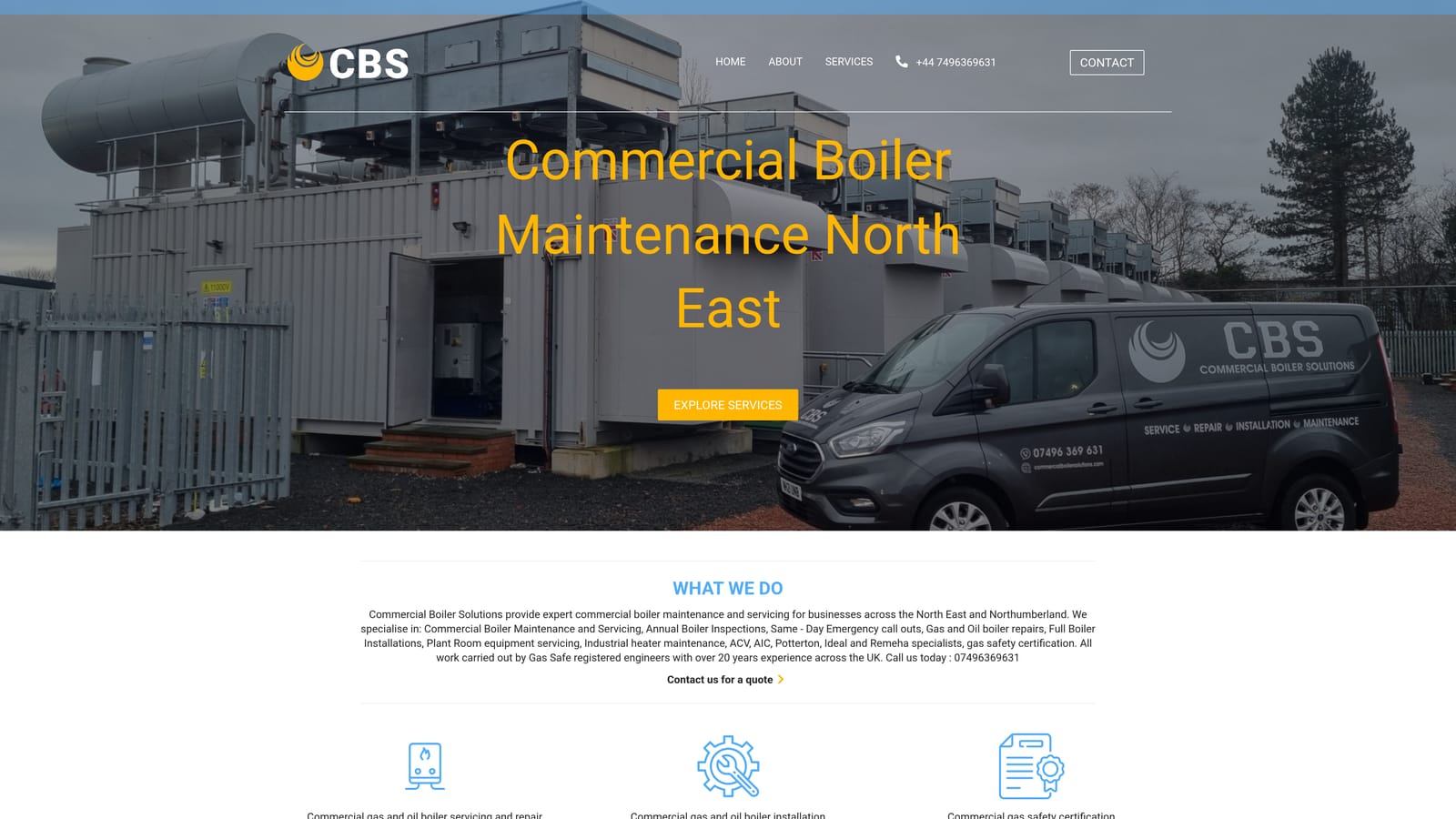
For commercial property managers in the North East, having a local Gas Safe registered contractor on a planned maintenance contract removes a significant compliance headache. Rather than scrambling to find a qualified engineer each year, a contract locks in annual inspections, routine servicing and emergency callout cover under a single arrangement.
The regional focus matters here. North East winters place considerable demand on commercial heating systems, and older commercial stock across the region often means ageing infrastructure that benefits from consistent, attentive maintenance rather than a one-off annual visit. A contractor who knows the region and its building stock is a genuine operational advantage.
Gas Safe Registered Engineers: All work is carried out by Gas Safe registered engineers, satisfying your legal obligations under the Gas Safety (Installation and Use) Regulations 1998.
Annual Inspection and Servicing: Planned maintenance contracts include annual inspections and servicing, keeping appliances running safely and efficiently.
To understand exactly what a visit involves, our guide to commercial boiler annual service what to expect walks through each stage from arrival to the final written report.
Emergency Callout Cover: Emergency callout availability means you are not left without support when a boiler fails mid-winter — a critical consideration for commercial premises that cannot afford prolonged heating downtime.
Component Replacement: Gas repairs and component replacement are covered, reducing the number of separate contractors you need to manage.
Regional Coverage: Serves the full North East and Northumberland area, with a 5-star customer rating built on prompt, reliable service.
Commercial property owners, landlords and facility managers across the North East and Northumberland who need a single, accountable Gas Safe registered contractor for planned maintenance, annual inspections and emergency cover. Particularly well-suited to those managing properties where heating reliability is operationally critical.
Contact Commercial Boiler Solutions directly for a tailored contract quote based on your property type, appliance inventory and coverage requirements.
Best for: Verifying that any gas engineer you engage is legally qualified to carry out work on your premises.
The Gas Safe Register is the UK's only legally recognised register of qualified gas engineers, maintained on behalf of the Health and Safety Executive.
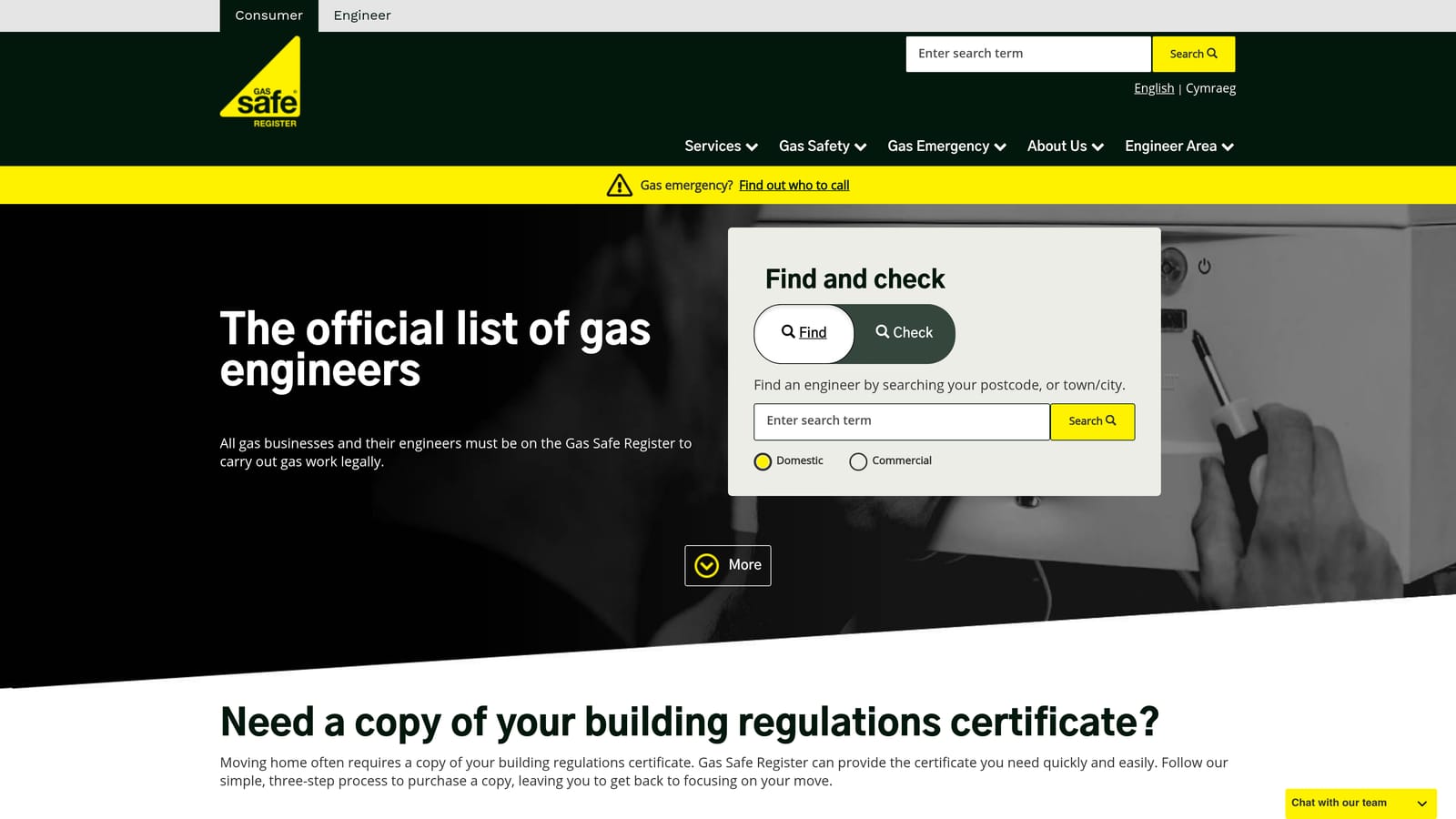
Before any engineer touches a gas appliance on your commercial premises, you have a responsibility to confirm they are Gas Safe registered. The register's free online search makes this straightforward: search by engineer name or registration number and confirm their qualifications in seconds.
Crucially, the register also shows which categories of gas appliance an engineer is qualified to work on. A registration for domestic boilers does not automatically cover commercial catering equipment or large commercial heating plant. This distinction matters enormously for compliance.
Free Public Search: Search by engineer name or Gas Safe registration number at no cost.
Category Confirmation: Confirms which gas appliance types and categories the engineer holds qualifications for.
Legally Mandated Register: Replaced CORGI registration in 2009 and remains the definitive legal standard for gas engineer qualification in the UK.
Due Diligence Record: Using the register creates a documented check you can reference if your maintenance records are ever audited.
Every commercial property manager and facility manager in the UK. This is non-negotiable due diligence — use it before engaging any gas contractor, regardless of how well-established they appear.
Free to use for property owners and managers.
Best for: Understanding your legal obligations as an employer or commercial property owner regarding gas safety and maintenance.
The Health and Safety Executive's gas safety guidance hub is the authoritative online resource for UK employers and property owners navigating their duties under gas safety legislation.
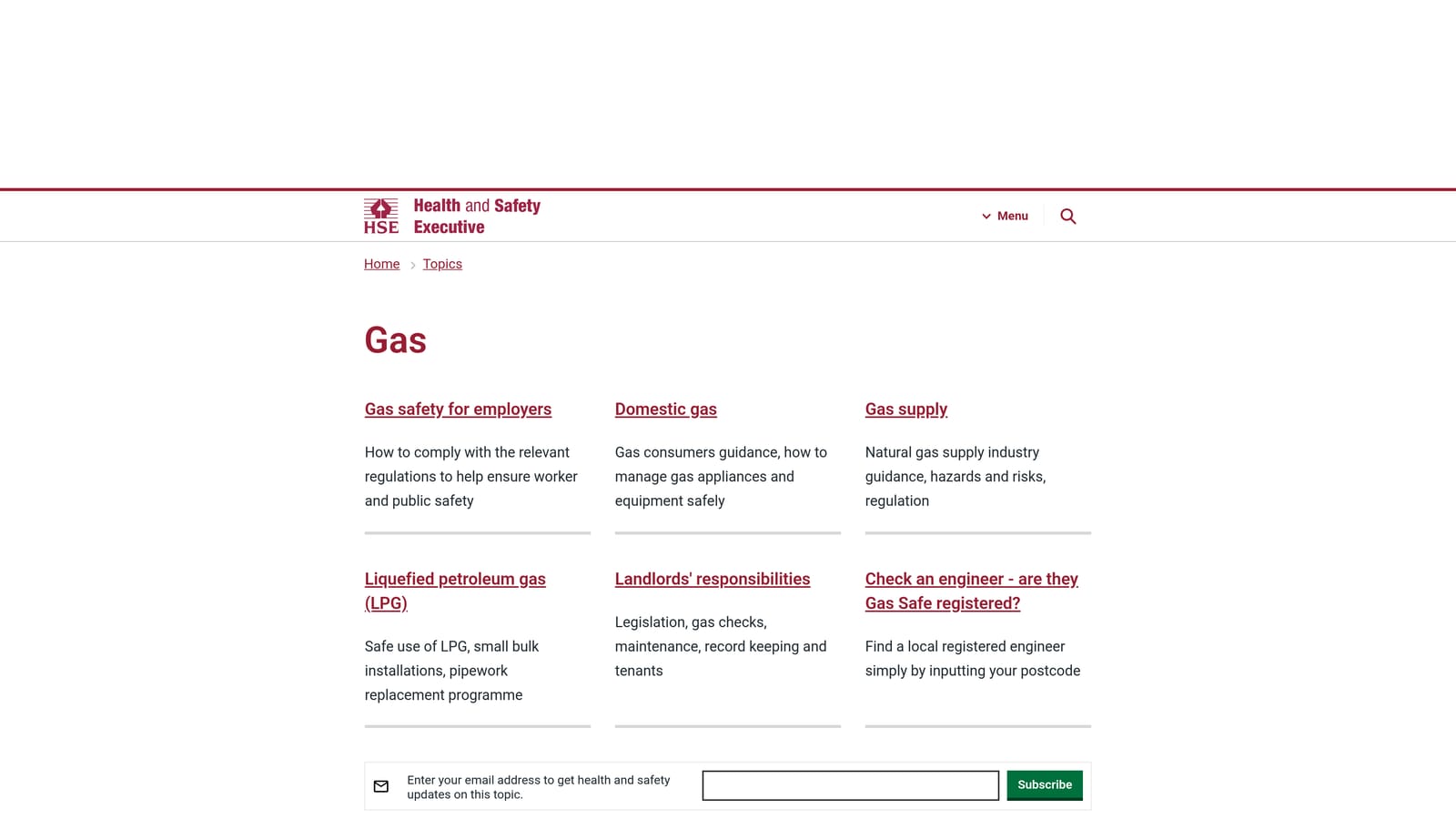
The HSE guidance cuts through ambiguity on what the law actually requires. For commercial property managers, this is particularly valuable when establishing or reviewing a planned maintenance programme. It sets out employer and landlord duties clearly, without the interpretation risk that comes with relying on third-party summaries.
The guidance covers maintenance duties, flue safety, risk assessment and the responsibilities that fall on different parties in multi-occupancy commercial buildings. It is updated to reflect regulatory changes, so it remains a reliable reference point over time.
Employer and Landlord Duties: Clear guidance on obligations under the Gas Safety (Installation and Use) Regulations 1998 and the Health and Safety at Work Act 1974.
Maintenance and Flue Safety Guidance: Specific guidance on gas appliance maintenance, flue integrity and risk assessment requirements.
Government-Backed Authority: No interpretation risk — this is the regulator's own guidance.
Regularly Updated: Reflects current regulatory requirements rather than outdated practice.
Facility managers, property managers and commercial landlords who want to understand their precise legal obligations before commissioning a maintenance programme, or who are reviewing existing arrangements against current regulatory requirements.
Free to access.
Best for: Accessing industry-recognised technical standards that underpin planned maintenance programmes for commercial gas installations.
The Institution of Gas Engineers and Managers (IGEM) publishes the technical standards and guidance documents that Gas Safe engineers and compliance teams use when designing and implementing maintenance programmes.
If you want your maintenance programme to be defensible under audit or inspection, referencing IGEM standards gives it a credible technical foundation. IGEM/UP/4, for example, addresses commercial gas installation standards and is widely used by engineers and compliance professionals working on commercial premises.
For facility managers tendering maintenance contracts or reviewing contractor proposals, familiarity with IGEM guidance helps you assess whether a proposed programme meets recognised industry benchmarks rather than accepting a contractor's word for it.
IGEM/UP/4 Standard: Covers commercial gas installation standards and service interval benchmarks relevant to planned maintenance.
Industry-Recognised Benchmarks: Used by Gas Safe engineers and compliance teams across the UK.
Audit Trail Support: Referencing IGEM standards in your maintenance documentation strengthens your compliance record.
Technical Authority: Provides the engineering basis for maintenance decisions rather than relying on informal practice.
Facilities managers, compliance officers and property managers who want to understand the technical standards their contractors should be working to, particularly on larger or more complex commercial gas installations.
Some IGEM documents are available free of charge; others require membership or individual purchase. Check the IGEM website for current availability.
Best for: Multi-site operators and larger estates needing to schedule, track and document planned preventive maintenance across multiple gas appliances and properties.
Computer-Aided Facilities Management (CAFM) platforms such as Planon, FSI Concept and Concept Evolution allow facilities teams to automate and manage planned preventive maintenance tasks across complex property portfolios.
For facility managers responsible for multiple commercial properties across the North East, manually tracking gas appliance service dates, inspection records and contractor visits quickly becomes unmanageable. CAFM software centralises all of this, sending automated reminders when servicing is due and maintaining a searchable digital record of every inspection.
This is particularly valuable when you need to demonstrate compliance. A well-maintained CAFM record showing scheduled gas appliance servicing, contractor details and inspection outcomes is a strong foundation for any audit or insurance review.
Automated Service Reminders: Schedules gas appliance servicing intervals and sends alerts when tasks are due.
Digital Record-Keeping: Maintains a complete audit trail of all servicing, inspections and contractor visits.
Multi-Site Management: Handles maintenance scheduling across large estates and multiple properties from a single platform.
FM Integration: Incorporates gas maintenance into broader facilities management workflows alongside other building services.
Facilities managers overseeing multiple commercial properties or large estates where manual tracking is no longer practical. Less relevant for single-site operators with straightforward maintenance needs.
Varies by platform and estate size; typically subscription-based. Contact individual vendors for quotes tailored to your portfolio.
Best for: Facilities teams wanting continuous performance data on commercial boilers and heating plant between scheduled Gas Safe inspections.
Building Management Systems (BMS) and IoT-enabled boiler monitoring platforms track operational data such as temperature, pressure and run hours, providing a continuous picture of heating plant performance.
A BMS does not replace a Gas Safe inspection. It is important to be clear on that point. What it does is give your facilities team early visibility of performance changes that may indicate a problem developing between scheduled services. A pressure anomaly or efficiency drop flagged by a BMS can prompt a timely engineer visit before a minor issue becomes a significant failure.
For larger commercial sites in the North East with substantial heating plant, BMS monitoring adds an intelligent layer of oversight that supports your planned maintenance programme rather than substituting for it. Any remedial gas work identified as a result must be carried out by a Gas Safe registered engineer.
Continuous Performance Monitoring: Tracks temperature, pressure and efficiency data between scheduled Gas Safe inspections.
Anomaly Alerts: Flags pressure drops, efficiency changes or unusual operating patterns that may warrant an engineer review.
Data-Informed Decisions: Supports better decisions about when to call an engineer, rather than relying solely on fixed calendar intervals.
Infrastructure Integration: Integrates with existing building infrastructure on larger commercial sites.
Larger commercial properties and multi-building estates where heating plant complexity and operational risk justify investment in continuous monitoring. Typically less cost-effective for smaller single-site commercial premises.
Varies significantly by system complexity and site size. Contact BMS providers directly for site-specific quotations.
Best for: Establishing technically grounded, standards-aligned maintenance frequencies for gas-fired heating systems in commercial buildings.
The Building Engineering Services Association (BESA) and the Chartered Institution of Building Services Engineers (CIBSE) publish the UK's leading technical references for planned maintenance across building services, including gas-fired heating.

When a contractor tells you a gas appliance needs servicing quarterly rather than annually, or vice versa, how do you assess whether that is reasonable? CIBSE Guide M and BESA's SFG20 standard give you an independent, industry-recognised benchmark against which to evaluate those recommendations.
SFG20 in particular sets out specific task frequencies and maintenance specifications for gas appliances, making it a practical reference for FM teams building or reviewing planned maintenance schedules. It is widely used by contractors and compliance consultants, so referencing it in tender documents and contracts creates a shared technical language with your service providers.
SFG20 Task Frequencies: Sets specific maintenance task frequencies and specifications for gas appliances and heating systems.
CIBSE Guide M Principles: Provides engineering and management principles for maintenance programme design.
Industry-Wide Adoption: Used by FM teams, contractors and compliance consultants across the UK.
Defensible Programmes: Referencing recognised standards strengthens the compliance case for your maintenance approach.
Facility managers, compliance officers and property managers building or auditing planned maintenance programmes for commercial properties, particularly those with complex or multi-system heating plant.
SFG20 is available via subscription through BESA. CIBSE Guide M and other CIBSE publications are available for purchase through the CIBSE website.
Best for: Immediate response to a suspected gas leak on commercial premises. This is not a maintenance tool — it is essential safety knowledge that every commercial property manager must have.
The National Gas Emergency Service is operated by the UK's gas distribution networks and provides free, 24/7 emergency response to gas leak reports.
No planned maintenance programme eliminates the possibility of a gas emergency. Every commercial property manager in the North East needs to know this number and have it displayed prominently on their premises. When a gas leak is suspected, the response must be immediate: leave the area at once, do not operate any electrical switches, do not use mobile phones in the vicinity, and call 0800 111 999 from a safe location.
Engineers from the gas distribution network will attend to make the situation safe. This service deals with the immediate emergency. Any subsequent gas work on your appliances or pipework must then be carried out by a Gas Safe registered engineer.
Free 24/7 Emergency Response: Available around the clock, every day of the year, at no cost.
Immediate Action Protocol: If you suspect a gas leak, leave the area immediately, do not operate switches, and call 0800 111 999 from a safe distance.
Network Engineer Attendance: Gas distribution network engineers will attend to make the premises safe.
Display Requirement: This number should be posted visibly in all commercial premises — boiler rooms, plant rooms, reception areas and staff notice boards.
Every commercial property in the UK. This is not a resource to evaluate — it is a number to memorise, display and act on without hesitation if a gas emergency occurs.
Free.
Planned maintenance for commercial gas systems requires more than booking an annual service call. It demands a layered approach: a trusted Gas Safe registered engineer for all hands-on work, solid record-keeping, clear regulatory awareness and the right supporting tools to keep everything on schedule and documented.
The resources in this list serve different purposes. The Gas Safe Register and HSE guidance establish your legal framework. IGEM, CIBSE and BESA standards give your programme a credible technical foundation. CAFM software and BMS monitoring help you manage and monitor between inspections. And the National Gas Emergency Service number sits above all of it as the non-negotiable safety backstop.
At the centre of a workable programme, however, is a reliable Gas Safe registered contractor who knows your property, your appliances and your compliance requirements. For commercial properties across Newcastle, Sunderland, Middlesbrough, Tyneside, Wearside, Teesside and Northumberland, Commercial Boiler Solutions provides Gas Safe registered maintenance contracts designed around your specific site, with annual inspections, emergency callout cover and a 5-star track record of prompt, professional service.
If you are ready to put a proper planned maintenance programme in place, learn more about our services and get in touch with the team to discuss a contract that works for your property.